Thursday, September 8, 2011

The Scarlet Pimpernel: Emmuska Orczy

This is a book that I read several years ago, and just decided to pick it up again this summer.  Emmuska Orczy does an excellent job of giving vivid description while leaving details out for the readers imagine.  I would highly recommend this book because of its redeeming qualities and self-sacrifice that are an essential part of the story.
Here is a brief summary of the story to get you interested: This story occurs during the French revolution, when the people rose up to throw off the restraint of the French Aristocracy.  The British are sympathetic towards the French "arito's," and one Englishman in particular has sworn to save all that he can from the guillotine.  He forms "the league of the scarlet pimpernel," the name of a common English flower.  This book is about his daring adventures to save a family of French aristocrats while his enemies are plotting to discover his identity.

Here is a brief excerpt from the book, when Sir Percy (the Scarlet Pimpernel) and his wife just parted from each other.


"Had she but turned back then, and looked out once more on to the rose-lit garden, she would have seen that which would have made her own sufferings seem but light and easy to bear--a strong man, overwhelmed with his own passion and despair. Pride had given way at last, obstinacy was gone: the will was powerless. He was but a man madly, blindly, passionately in love and as soon as her light footstep had died away within the house, he knelt down upon the terrace steps, and in the very madness of his love he kissed one by one the places where her small foot had trodden, and the stone balustrade, where her tiny hand had rested last." 

Friday, July 22, 2011

The Count of Monte Cristo

This is one of my all-time favorite books! I just picked it up again this summer and was reading through it again, so i thought that I would share some lines.

"Life is a storm, my young friend. You will bask in the sunlight one moment, be shattered on the rocks the next. What makes you a man is what you do when that storm comes. You must look into that storm and shout as you did in Rome. Do your worst, for I will do mine! " [Edmond giving advice to Albert]


"Hatred is blind; rage carries you away; and he who pours out vengeance runs the risk of tasting a bitter draught." 


"Fool that I am," said he,"that I did not tear out my heart the day I resolved to revenge myself"


"There is neither happiness nor unhappiness in this world; there is only the comparison of one state with another. Only a man who has felt ultimate despair is capable of feeling ultimate bliss. It is necessary to have wished for death in order to know how good it is to live.....the sum of all human wisdom will be contained in these two words: Wait and Hope" [I would add...in God]


If you find yourself bored this summer, I would recommend reading this book, and others by Alexandre Dumas that I have read and enjoyed, namely, The Three Musketeers, the Man in the Iron Mask, and The Black Tulip. 

Sunday, July 3, 2011

Independence Day

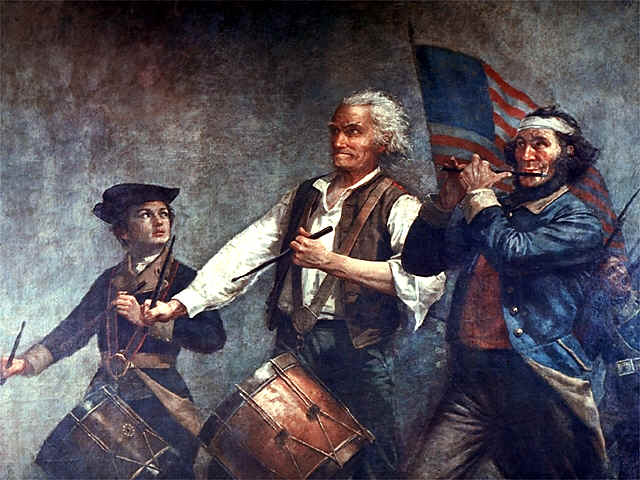
In honor of the Fourth of July I wanted to post one of my all-time favorite poems, Paul Revere's Ride.


Listen, my children, and you shall hear
Of the midnight ride of Paul Revere,
On the eighteenth of April, in Seventy-five;
Hardly a man is now alive
Who remembers that famous day and year.
He said to his friend, ‘If the British march
By land or sea from the town to-night,
Hang a lantern aloft in the belfry arch
Of the North Church tower as a signal light,—
One, if by land, and two, if by sea;
And I on the opposite shore will be,
Ready to ride and spread the alarm
Through every Middlesex village and farm,
For the country folk to be up and to arm.’

Then he said, ‘Good-night!’ and with muffled oar
Silently rowed to the Charlestown shore,
Just as the moon rose over the bay,
Where swinging wide at her moorings lay
The Somerset, British man-of-war;
A phantom ship, with each mast and spar
Across the moon like a prison bar,
And a huge black hulk, that was magnified
By its own reflection in the tide.

Meanwhile, his friend, through alley and street,
Wanders and watches with eager ears,
Till in the silence around him he hears
The muster of men at the barrack door,
The sound of arms, and the tramp of feet,
And the measured tread of the grenadiers,
Marching down to their boats on the shore.

Then he climbed the tower of the Old North Church,
By the wooden stairs, with stealthy tread,
To the belfry-chamber overhead,
And startled the pigeons from their perch
On the sombre rafters, that round him made
Masses and moving shapes of shade,—
By the trembling ladder, steep and tall,
To the highest window in the wall,
Where he paused to listen and look down
A moment on the roofs of the town,
And the moonlight flowing over all.

Beneath, in the churchyard, lay the dead,
In their night-encampment on the hill,
Wrapped in silence so deep and still
That he could hear, like a sentinel’s tread,
The watchful night-wind, as it went
Creeping along from tent to tent,
And seeming to whisper, ‘All is well!’
A moment only he feels the spell
Of the place and the hour, and the secret dread
Of the lonely belfry and the dead;
For suddenly all his thoughts are bent
On a shadowy something far away,
Where the river widens to meet the bay,—
A line of black that bends and floats
On the rising tide, like a bridge of boats.

Meanwhile, impatient to mount and ride,
Booted and spurred, with a heavy stride
On the opposite shore walked Paul Revere.
Now he patted his horse’s side,
Now gazed at the landscape far and near,
Then, impetuous, stamped the earth,
And turned and tightened his saddle-girth;
But mostly he watched with eager search
The belfry-tower of the Old North Church,
As it rose above the graves on the hill,
Lonely and spectral and sombre and still.
And lo! as he looks, on the belfry’s height
A glimmer, and then a gleam of light!
He springs to the saddle, the bridle he turns,
But lingers and gazes, till full on his sight
A second lamp in the belfry burns!

A hurry of hoofs in a village street,
A shape in the moonlight, a bulk in the dark,
And beneath, from the pebbles, in passing, a spark
Struck out by a steed flying fearless and fleet;
That was all! And yet, through the gloom and the light,
The fate of a nation was riding that night;
And the spark struck out by that steed, in his flight,
Kindled the land into flame with its heat.

He has left the village and mounted the steep,
And beneath him, tranquil and broad and deep,
Is the Mystic, meeting the ocean tides;
And under the alders that skirt its edge,
Now soft on the sand, now loud on the ledge,
Is heard the tramp of his steed as he rides.
It was twelve by the village clock,
When he crossed the bridge into Medford town.
He heard the crowing of the cock,
And the barking of the farmer’s dog,
And felt the damp of the river fog,
That rises after the sun goes down.

It was one by the village clock,
When he galloped into Lexington.
He saw the gilded weathercock
Swim in the moonlight as he passed,
And the meeting-house windows, blank and bare,
Gaze at him with a spectral glare,
As if they already stood aghast
At the bloody work they would look upon.

It was two by the village clock,
When he came to the bridge in Concord town.
He heard the bleating of the flock,
And the twitter of birds among the trees,
And felt the breath of the morning breeze
Blowing over the meadows brown.
And one was safe and asleep in his bed.
Who at the bridge would be first to fall,
Who that day would be lying dead,
Pierced by a British musket-ball.

You know the rest. In the books you have read,
How the British Regulars fired and fled,—
How the farmers gave them ball for ball,
From behind each fence and farm-yard wall,
Chasing the red-coats down the lane,
Then crossing the fields to emerge again
Under the trees at the turn of the road,
And only pausing to fire and load.

So through the night rode Paul Revere;
And so through the night went his cry of alarm
To every Middlesex village and farm,—
A cry of defiance and not of fear,
A voice in the darkness, a knock at the door
And a word that shall echo forevermore!
For, borne on the night-wind of the Past,
Through all our history, to the last,
In the hour of darkness and peril and need,
The people will waken and listen to hear
The hurrying hoof-beats of that steed,
And the midnight message of Paul Revere.

http://libcom.org/files/images/history/American-revolution.jpg

Thursday, June 30, 2011

Robert Frost: The Road Not Taken

TWO roads diverged in a yellow wood,
And sorry I could not travel both
And be one traveler, long I stood
And looked down one as far as I could
To where it bent in the undergrowth;        5 


Then took the other, as just as fair,
And having perhaps the better claim,
Because it was grassy and wanted wear;
Though as for that the passing there
Had worn them really about the same,        10 


And both that morning equally lay
In leaves no step had trodden black.
Oh, I kept the first for another day!
Yet knowing how way leads on to way,
I doubted if I should ever come back.        15


I shall be telling this with a sigh
Somewhere ages and ages hence:
Two roads diverged in a wood, and I—
I took the one less traveled by,
And that has made all the difference.        20 

Sidney Lanier: The Dying Words of Jackson

"Order A. P. Hill to prepare for battle."
"Tell Major Hawks to advance the Commissary train."
"Let us cross the river and rest in the shade."


The stars of Night contain the glittering Day
And rain his glory down with sweeter grace
Upon the dark World's grand, enchanted face --
All loth to turn away.

And so the Day, about to yield his breath,
Utters the stars unto the listening Night,
To stand for burning fare-thee-wells of light
Said on the verge of death.

O hero-life that lit us like the sun!
O hero-words that glittered like the stars
And stood and shone above the gloomy wars
When the hero-life was done!

The phantoms of a battle came to dwell
I' the fitful vision of his dying eyes --
Yet even in battle-dreams, he sends supplies
To those he loved so well.

His army stands in battle-line arrayed:
His couriers fly: all's done: now God decide!
-- And not till then saw he the Other Side
Or would accept the shade.

Thou Land whose sun is gone, thy stars remain!
Still shine the words that miniature his deeds.
O thrice-beloved, where'er thy great heart bleeds,
Solace hast thou for pain!

I love the line of this poem that shows Jackson's belief that God knew the time that he would die, so he "lived his life to the fullest." He was not afraid of risks because he knew that he was in the hands of God.
 

Monday, April 25, 2011

Emily Dickinson: Success

This is another one of Dickinson's poems that I really like because of how thought provoking it is and how she paints pictures in my mind with so few words.  
Though none of her original poems were titled, the editor called this one "Success."


Success is counted sweetest 
By those who ne'er succeed. 
To comprehend a nectar 
Requires sorest need.


Not one of all the purple host
Who took the flag to-day
Can tell the definition,
So clear, of victory!

As he, defeated, dying,
On whose forbidden ear
The distant strains of triumph
Burst agonized and clear!

What she is saying in this poem is so true.  It is the person that was so close to success and victory and yet ended the day defeated that knows the true definition of success rather than the victorious one.  

Thursday, April 21, 2011

Emily Dickinson: Hope

This is one of my favorite poems by one of my favorite poets.  Emily Dickinson is very unique in her poetry because she mostly wrote from her imagination.  She was VERY shy her entire life, and lived in seclusion, and has a very interesting outlook on life because of this seclusion.  I love how she describes hope in this poem.  

Hope is the thing with feathers 
That perches in the soul,
And sings the tune--without the words,
And never stops at all,

And sweetest in the gale is heard;
And sore must be the storm
That could abash the little bird
That kept so many warm.

I've heard it in the chillest land,
And on the strangest sea;
Yet, never, in extremity,
It asked a crumb of me.


Emily Dickinson is definitely one that I would love to write like some day, though never live like her.  I believe that God designed us to live in community.